faculties of mind
Mental Abilities & Multiple Intelligence

Thurston’s theory of Primary Mental Abilities and Gardener’s Multiple Intelligences both reject a single general intelligence (g-factor), proposing instead that human intelligence is multi-faceted.
Thurston identifies seven distinct cognitive factors focusing on cognitive skills, and these factors are independent meaning person can be high on one and low in another.
Gardner’s nine multiple intelligences propose, each intelligence focuses on practical abilities, drivers of talents and highly independent that operate in different areas of the brain.
Multiple Intelligence as Intellectual Competencies
Intelligence is the ability to navigate the brain system to provide significant individual and societal benefits. Models of intelligence first proposed by Louis Thurston in 1930 and later Howard Gardner 1983 – 1989 meaningfully refined it as Nine intelligence.
Multiple Intelligence or Faculties of Mind is not solely responsible for behavior formation as always believed. It primarily increases the acquired form of cognitive process through interaction with specific objects.
Multiple intelligence theory defines intellectual competencies rather than serving as a direct mechanism for behavior pattern formation in a way that psychological conditioning or personality theories might. Intelligence is not a fixed property and specific behavior that an individual develops is heavily influenced by genetics and internal & external environment. Therefore, high academic intelligence need not be a predictor for later success in life.
Learning and training new knowledge or skills evoke specific and repeated activity patterns, and in the process of Hebbian plasticity, neural pathways are reinforced by strengthening of specific synapses while less functional are eliminated (Growing Brains, Nurturing Minds: Hagar Goldberg)
Effects of Maternal Stress and shift in Intelligence
Every stand-alone intelligence or the faculty of mind is independent and multi-faceted. Maternal emotion during gestation increases the risk of the child having a range of neurodevelopmental outcomes.
An emotional state of an expectant mother can be of different types, for example an accident / fall, or an unintentional bump on a surface, or partner induced mental trauma, does induce a linear response effect. It is not necessary that all children get affected but certain children do get affected in different ways. During developmental stages the brain is constantly refining neural pathways which can cause speed of grasping and response.
Multiple Intelligence Position shift Childhood
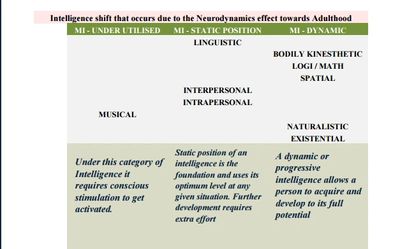
Multiple Intelligence shifts happen to some children as they are transitioning into adulthood, For certain children it may be in sustained child level position without any functional shift this process makes some children high academic achievers and later experience sustained cognitive decline or low academic achievers during first half becomes high practical performers in later half.
Modern research indicates that the brain works via complex, interconnected neural networks rather than completely separate, modular or autonomous intelligence zones. It is argued that the efficiency, structural complexity and functional connectivity of the brain’s neural networks, rather than just raw brain size or neuron count. It is therefore the neuronal complexity and efficiency such as IQ is associated with more complex dendrites in cortical pyramidal neurons.


Multiple Intelligence Shift in Adulthood
High performing children often show superior, rapid learning capabilities due to high neuroplasticity, and some of them experience a decline in learning efficiency by middle age. This is typically due to a drop in fluid intelligence, which includes processing speed and working memory.
A reduced fluidity as the neuroplasticity reduces and becomes Crystalized intelligence. To some cases the knowledge gained during the fluid state of intelligence becomes static state decreasing further fluidity and losing the speed of processing.
Another biological shift is from high plasticity to less selective memory where it is a shift from Fluid intelligence to Underutilized state of Intelligence. It is the process of storing outdated information, and when there is lack of consistent practice it takes process of “use it or lose it” state.
What is Multiple intelligence shift
RGB Analyzes by compounding these structural complexities and functional connectivity, takes the first approach by segregating & categorizing each faculty of mind according to the neural complexity, in capturing and retaining those attributes into
- Progressive state of Intelligence,
- Static state of Intelligence and
- Underutilized state of intelligence.
We may call it the Hebbian plasticity (Neurons that fire together wire together). Learning and training new knowledge or skills evoke specific and repeated activity patterns, where neural pathways are reinforced by strengthening of specific synapses while less functional are eliminated (Growing Brains, Nurturing Minds: Hagar Goldberg)
The shifts in the traits of intelligence are a gradual process. This process for some children causes cognitive fatigue, experiencing chronic stress, anxiety, sometimes total loss of interest in subjects that previously enjoyed, or loss of interest related to that professional function for adults. But for some others as adults these shifts make them more active, provide high mental energy, clarity and sustained focus on subjects once they disliked during childhood.
RGB Analyzes helps Parent-Child-Teacher to identify this phenomenon to prepare the child to overcome loss of cognitive vitality in late adulthood and help cognitive performance at early childhood.

Beyond shifts in Faculties of Mind
RGB Analyzes identifies and measures such consequences in shifts in Faculties of Mind based on the theory of Fluid Intelligence and Crystallized Intelligence proposed by Raymond Cattel 1976.
Crystalized Intelligence
The key aspect of Crystallized Intelligence accumulation of knowledge is happening through sedimentation process from continuous education, facts identification, and skills acquired through precipitation out of personal experience. This phase usually continues during childhood till about 35 to 40 years of age and shifts to independence and displays gradual emotional maturity as individuals grow older.
Fluid Intelligence
The key aspect of fluid intelligence is the capacity to think abstractly, solve problems without relying on pre-existing knowledge, education or experience and adapting to new situations with ease. This cognitive ability is at peak in during childhood and early adulthood, gradually declines around from around 30 to 40 years old
Rockomer Genetic Behavior Analyzes
RGB Analyzes report is an indicator for changes in capturing and retaining information. Though it remains as naturally happened, awareness of such changes can be controlled by constantly stimulating those neural pathways with constant stimulations through training & development and personalized coaching
Faculties of Mind and Professional Success
RGB Analyzes subject selection choice is not designed as a last-minute subject selection process for higher studies. Though school provides clear, fair metrics for success, after school adult life involves ambiguous goals, zero-sum competition, and the necessity of making imperfect choices where effort does not guarantee a specific result. The impact on neural pathway shifts and fluid & crystallized intelligence is instrumental for misaligned success metrics. These intangible neural behaviors cause psychological distress such as anxiety, depression, mental fatigue, loss of focus and other related mental health issues. Therefore, RGB Analyzes is designed to create structured environment for a reliance on natural giftedness.
Neurodiversity in Learning Process
Neurodiversity is about how individuals process information across different behavioral & academic frameworks that recognizes and values natural variations, but how human brains process information, learn and interact, rather than viewing differences like autism, ASD or Learning Disorder and dyslexia as deficits the root cause of such conditions can be found out through trait identification. This helps in Subject-wise learning involves recognizing how a brain process information involving lasting changes in both neuronal activity and connectivity that create enduring internal representations.

Higher Intelligence is not Better Behavior
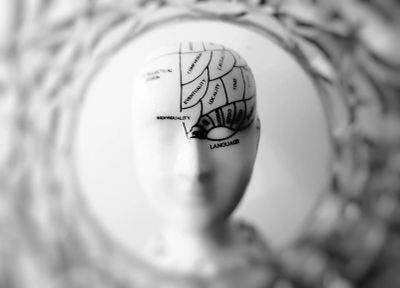
Cognitive process is a reciprocal activity of both intelligence and Behavior traits. Stand-alone traits of intelligence do not produce behavior nor its combination. It involves electro-biochemical role of the brain that governs all brain functions, which in turn drive behavior. Behavior is generated when these electrochemical signals act on specific neural circuits, affecting perception, mood, decision-making, memory, conscious and unconscious actions. The Correlations in these electro-biochemical activities reveal how rapid neurochemical actions change with behavior. These complexities are the neurogenetic effects in RGB Analyzes termed as Static and Fluid behavior traits.